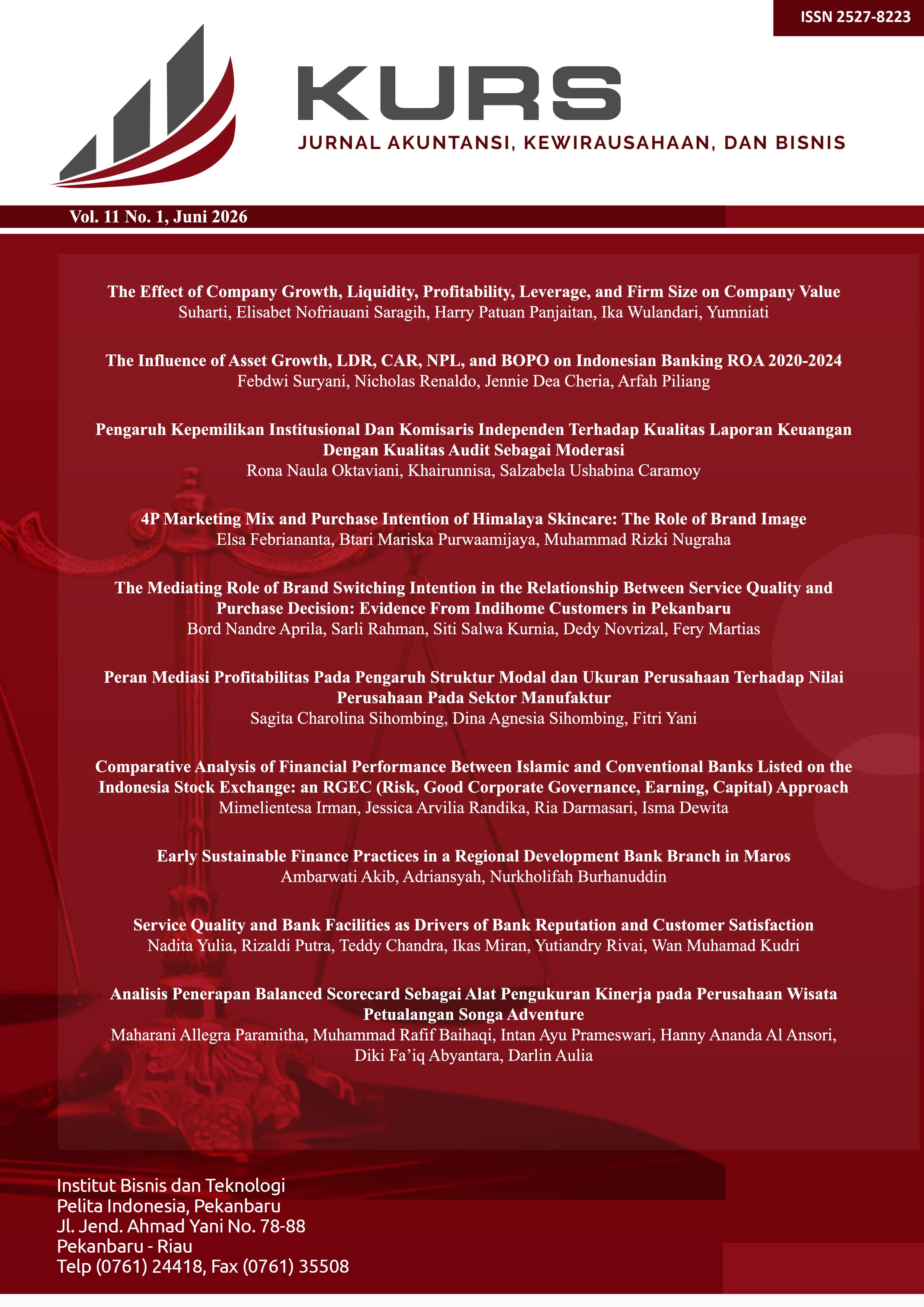
EARLY SUSTAINABLE FINANCE PRACTICES IN A REGIONAL DEVELOPMENT BANK BRANCH IN MAROS
DOI:
https://doi.org/10.35145/kurs.v11i1.6001Keywords:
green banking, green savings, MSME financing, regional development bank, sustainable finance, Bank Pembangunan Daerah, Keuangan Berkelanjutan, Pembiayaan UMKM, Tabungan HijauAbstract
Penelitian ini menganalisis praktik awal keuangan berkelanjutan pada Bank Sulselbar Cabang Maros sebagai cabang bank pembangunan daerah yang beroperasi dalam ekosistem ekonomi lokal. Isu ini penting karena praktik keberlanjutan pada tingkat cabang sering tidak terlihat dalam pelaporan keberlanjutan formal, padahal cabang menjadi penghubung langsung bank dengan pemerintah daerah, aparatur sipil negara, UMKM, dan masyarakat. Penelitian menggunakan pendekatan kualitatif deskriptif dengan desain studi kasus. Data utama diperoleh dari laporan wawancara lapangan tahun 2025, sedangkan data sekunder berasal dari regulasi keuangan dan literatur ilmiah tentang green banking, ESG, inklusi keuangan digital, dan tata kelola risiko perbankan. Data dianalisis secara tematik melalui empat dimensi, yaitu produk keuangan hijau, digitalisasi layanan, pembiayaan sektor produktif, dan tata kelola risiko. Hasil penelitian menunjukkan bahwa keuangan berkelanjutan pada cabang masih berada pada tahap inisiasi, yang tercermin pada pengembangan tabungan hijau, pembiayaan ramah lingkungan percontohan, mobile banking, integrasi QRIS dan e-wallet, kredit UMKM, serta penilaian risiko berbasis KYC, AML, SLIK, dan 5C. Penelitian menyimpulkan bahwa praktik cabang dapat mendukung keuangan berkelanjutan apabila diperkuat melalui dokumentasi, pemetaan portofolio, dan indikator risiko lingkungan-sosial.
This study examines early sustainable finance practices at Bank Sulselbar Maros Branch as a regional development bank branch embedded in a local economic ecosystem. The issue is important because branch-level sustainable finance practices are often less visible in formal sustainability reporting, even though branches connect banks directly with local governments, civil servants, MSMEs, and communities. The research uses a descriptive qualitative approach with a case study design. Primary data were obtained from a 2025 field interview report, while secondary data came from financial regulations and scholarly literature on green banking, ESG, digital financial inclusion, and banking risk governance. The data were analysed thematically through four dimensions: green financial products, service digitalisation, productive-sector financing, and risk governance. The findings show that sustainable finance at the branch remains at an initiation stage, reflected in green savings development, pilot environmentally friendly financing, mobile banking, QRIS and e-wallet integration, credit provision for MSMEs, and KYC, AML, SLIK, and 5C-based risk assessment. The study concludes that branch practices can support sustainable finance when strengthened through documentation, portfolio mapping, and environmental-social risk indicators.
Downloads
References
Alsayegh, M. F., Abdul Rahman, R., & Homayoun, S. (2020). Corporate economic, environmental, and social sustainability performance transformation through ESG disclosure. Sustainability, 12(9), 3910. https://doi.org/10.3390/su12093910
Bose, S., Khan, H. Z., Rashid, A., & Islam, S. (2018). What drives green banking disclosure? An institutional and corporate governance perspective. Asia Pacific Journal of Management, 35(2), 501-527. https://doi.org/10.1007/s10490-017-9528-x
Braun, V., & Clarke, V. (2006). Using thematic analysis in psychology. Qualitative Research in Psychology, 3(2), 77-101. https://doi.org/10.1191/1478088706qp063oa
Flammer, C. (2021). Corporate green bonds. Journal of Financial Economics, 142(2), 499-516. https://doi.org/10.1016/j.jfineco.2021.01.010
Gianfrate, G., & Peri, M. (2019). The green advantage: Exploring the convenience of issuing green bonds. Journal of Cleaner Production, 219, 127-135. https://doi.org/10.1016/j.jclepro.2019.02.022
Handajani, L., Rifai, A., & Husnan, L. H. (2019). Study of the initiation of green banking practices at state-owned bank. Jurnal Economia, 15(1), 1-16. https://doi.org/10.21831/economia.v15i1.21954
Kelompok 4. (2025). Laporan wawancara Bank Pembangunan Daerah Sulawesi Selatan dan Sulawesi Barat (Bank Sulselbar) Cabang Maros. Program Studi Pendidikan Akuntansi, Fakultas Ekonomi dan Bisnis, Universitas Negeri Makassar. Unpublished manuscript.
Khan, M., Serafeim, G., & Yoon, A. (2016). Corporate sustainability: First evidence on materiality. The Accounting Review, 91(6), 1697-1724. https://doi.org/10.2308/accr-51383
Kumar, K., & Prakash, A. (2019). Examination of sustainability reporting practices in Indian banking sector. Asian Journal of Sustainability and Social Responsibility, 4, Article 2. https://doi.org/10.1186/s41180-018-0022-2
Nizam, E., Ng, A., Dewandaru, G., Nagayev, R., & Nkoba, M. A. (2019). The impact of social and environmental sustainability on financial performance: A global analysis of the banking sector. Journal of Multinational Financial Management, 49, 35-53. https://doi.org/10.1016/j.mulfin.2019.01.002
Omar, M. A., & Inaba, K. (2020). Does financial inclusion reduce poverty and income inequality in developing countries? A panel data analysis. Journal of Economic Structures, 9, Article 37. https://doi.org/10.1186/s40008-020-00214-4
Otoritas Jasa Keuangan. (2017). Peraturan Otoritas Jasa Keuangan Nomor 51/POJK.03/2017 tentang penerapan keuangan berkelanjutan bagi lembaga jasa keuangan, emiten, dan perusahaan publik.
Otoritas Jasa Keuangan. (2021). Roadmap keuangan berkelanjutan tahap II (2021-2025). Otoritas Jasa Keuangan.
Otoritas Jasa Keuangan. (2024). Roadmap penguatan bank pembangunan daerah 2024-2027. Otoritas Jasa Keuangan.
Otoritas Jasa Keuangan. (2026). Taksonomi untuk Keuangan Berkelanjutan Indonesia (TKBI) versi 3. Otoritas Jasa Keuangan.
Ozili, P. K. (2018). Impact of digital finance on financial inclusion and stability. Borsa Istanbul Review, 18(4), 329-340. https://doi.org/10.1016/j.bir.2017.12.003
Park, H., & Kim, J. D. (2020). Transition towards green banking: Role of financial regulators and financial institutions. Asian Journal of Sustainability and Social Responsibility, 5, Article 5. https://doi.org/10.1186/s41180-020-00034-3
Ridder, H. G. (2017). The theory contribution of case study research designs. Business Research, 10(2), 281-305. https://doi.org/10.1007/s40685-017-0045-z
Salsabila, M., & Adhariani, D. (2023). How green is green banking? An analysis of slack and green practices in the banking industry. In Research in Finance (Vol. 37, pp. 63-79). Emerald Publishing. https://doi.org/10.1108/S0196-382120230000037004
Senyo, P. K., & Osabutey, E. L. C. (2020). Unearthing antecedents to financial inclusion through fintech innovations. Technovation, 98, 102155. https://doi.org/10.1016/j.technovation.2020.102155
Widarwati, E., Solihin, A., & Nurmalasari. (2022). Digital finance for improving financial inclusion Indonesians' banking. Signifikan: Jurnal Ilmu Ekonomi, 11(1), 17-30. https://doi.org/10.15408/sjie.v11i1.17884
Xie, J., Nozawa, W., Yagi, M., Fujii, H., & Managi, S. (2019). Do environmental, social, and governance activities improve corporate financial performance? Business Strategy and the Environment, 28(2), 286-300. https://doi.org/10.1002/bse.2224
Yip, A. W. H., & Bocken, N. M. P. (2018). Sustainable business model archetypes for the banking industry. Journal of Cleaner Production, 174, 150-169. https://doi.org/10.1016/j.jclepro.2017.10.190
Yue, P., Korkmaz, A. G., Yin, Z., & Zhou, H. (2022). The rise of digital finance: Financial inclusion or debt trap? Finance Research Letters, 47, 102604. https://doi.org/10.1016/j.frl.2021.102604
Downloads
Published
Issue
Section
License
Copyright (c) 2026 Kurs : Jurnal Akuntansi, Kewirausahaan dan Bisnis

This work is licensed under a Creative Commons Attribution-ShareAlike 4.0 International License.